Executive Summary
AI has moved from experiment to infrastructure. 88% of organizations now use AI in at least one business function, and more than 80% of the Fortune 500 are already running AI agents in production. These systems have stopped simply answering questions. They now plan, decide, and act on your data.
Security has not kept pace. 97% of the organizations that suffered an AI-related breach lacked basic AI access controls, and reported AI incidents rose to 362 in 2025, up from 233 the year before. We see the same pattern in almost every enterprise we work with. Adoption raced ahead while visibility, ownership, and controls fell behind. What used to be an IT concern is now sitting on the enterprise risk register.
This edition sets out a practical way to close that gap: one mental model for reasoning about any AI system, seven control domains that line up with the major frameworks, and a 90-day path from scattered pilots to a governed program.
AI Risk Is Now Enterprise Risk
Four data points frame the moment:
Adoption is now near-universal, and it is increasingly agentic: the systems don't only generate output, they take action. Governance and controls are still catching up. Once a wrong answer can trigger a wrong action, the cost of that lag stops being theoretical.
Why Traditional Security Doesn't Cover AI
Most of our security controls rest on three assumptions. AI breaks all three, and each break opens a new risk that needs a new control.
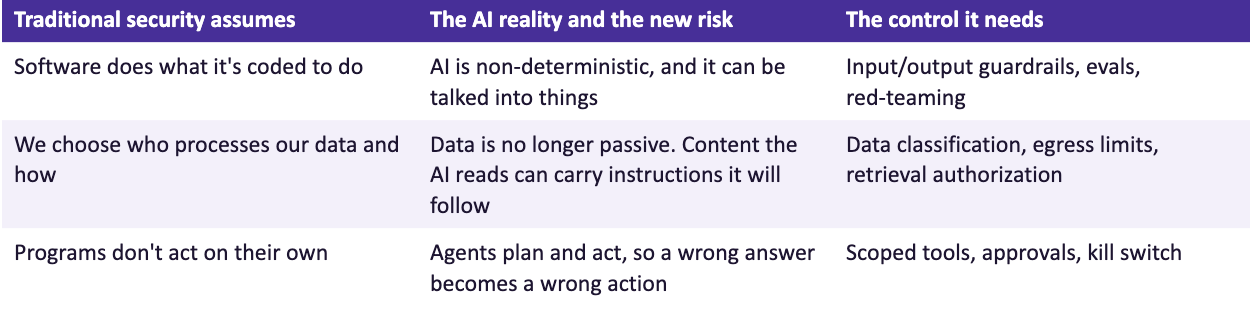
The point for security leaders is straightforward. AI has to be governed on its own terms. Bolting it onto a program designed for deterministic software with a fixed boundary won't hold.
The Map: Where AI Crosses Your Trust Boundaries
Every AI pattern crosses a different trust boundary, meaning the point where your data or your control passes to something you don't own. Once you know which boundary is being crossed, you know where the risk actually sits.
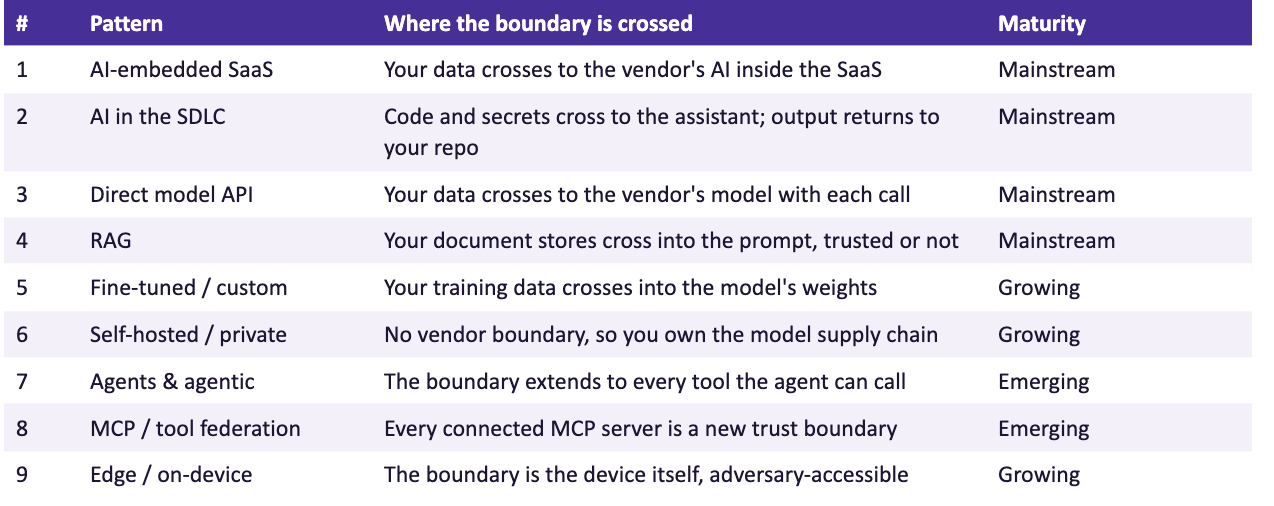
Whether you consume (you control the config and the data, but not the model) or build (you own the architecture), the risk comes down to the same two things: what the AI can see, and what it can do.
One Mental Model: What It Can See × What It Can Do
You don't need a separate risk framework for every tool. Two questions are enough to place any AI system:
Plot those two against each other and four postures fall out:
A third factor sits underneath the grid: the pattern, or how the system is actually built. The same box can call for very different controls depending on whether it's RAG, fine-tuned, agentic, or MCP-federated. Same posture, different plumbing, different safeguards.
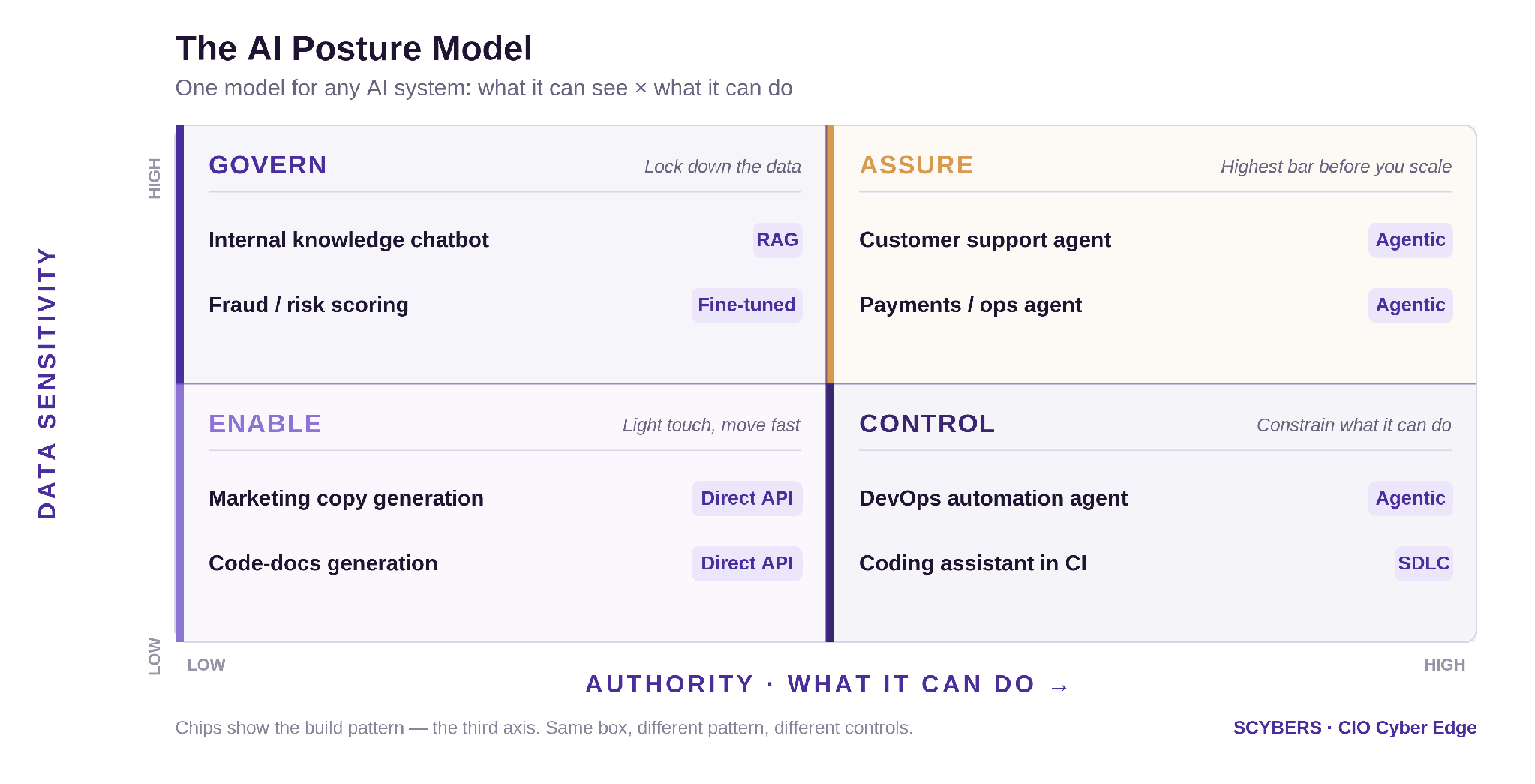
The AI Posture Model: what it can see × what it can do.
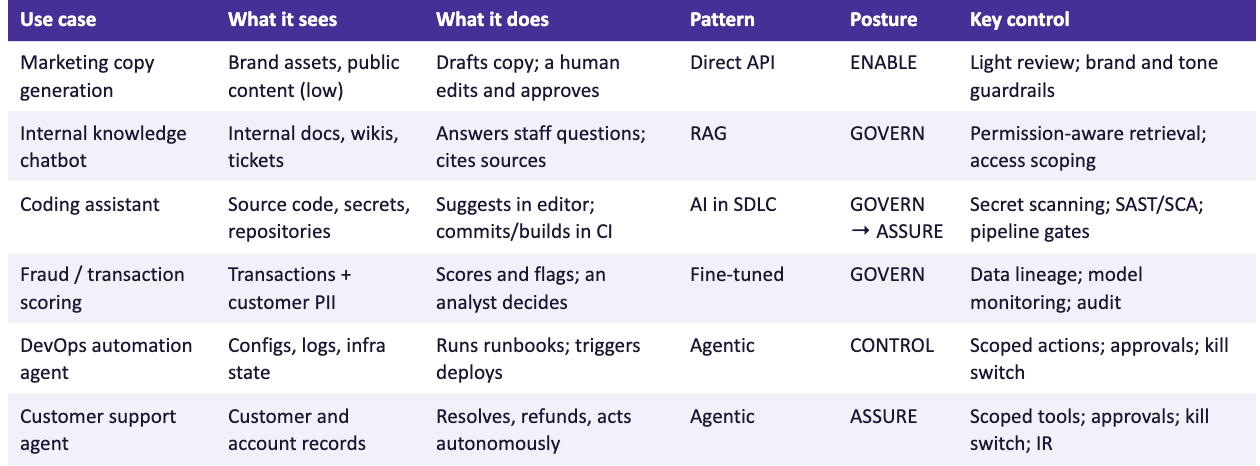
The model in use
Here's how AI that's already in production sorts against the model:
From Patterns to Program: Seven Control Domains
The per-use-case controls roll up into seven domains. Each one is dialed to the system's posture, so it stays light for ENABLE and gets exhaustive for ASSURE.
These seven map cleanly onto the frameworks most CIOs are already being measured against: NIST AI RMF, ISO/IEC 42001, OWASP LLM and Agentic, MITRE ATLAS, and Google SAIF. Use the frameworks to check your coverage, not as a badge to bolt on. If one of them names a risk your seven domains can't hold, that's the gap to close.
The Blind Spot: You Can't Govern What You Can't See
None of this works if you can't see it. Shadow AI is every one of these patterns running ungoverned and invisible. You carry the full risk with none of the controls, and often with no way to know it's even there.
The one job unique to shadow AI is finding it. Once it's found and sanctioned, you govern it like everything else, through the same see × do × pattern model.
A 90-Day Path (Discover → Govern → Assure)
You can move now in three focused phases, and prove value before scaling the commitment.
Days 0–30 · DISCOVER. Inventory AI across all patterns, surface the shadow AI, tier every system by see × do × pattern, and land a few quick-win data and access fixes.
Days 30–60 · GOVERN. Publish an AI usage policy and a sanctioned tool catalogue. Get connector and OAuth governance in place, set secure-by-design standards, and map your controls to SAIF and NIST AI RMF.
Days 60–90 · ASSURE. Red-team the highest-risk systems, stand up runtime detection and IR playbooks, and produce a board-ready posture report with a roadmap to scale safely.
The starting ask is small on purpose: a 30-day discovery. Find your AI, sort it with the model, and you have a program instead of a scatter-gun.
Strategic Recommendations for CIOs and CISOs
Final Word: Govern AI on Its Own Terms
AI adoption is already near-universal, and it is getting more agentic every quarter. The organizations that get hurt won't be the ones that moved fast. They'll be the ones that moved fast without visibility, ownership, or controls. That's what the numbers keep exposing: 97% of AI-breached organizations had no AI access controls, and incident counts are still climbing year over year.
You don't close that gap with a new tool or a longer policy. You close it with a model simple enough to apply to every system, what can it see, what can it do, how is it built, and a program that dials the right controls to each answer.
Start small and start now. Find your AI, sort it with the model, and you'll have a program instead of a scatter-gun.
Scybers is a specialized global cybersecurity firm with deep front-line expertise in security strategy, security engineering, and security operations management. A Mastercard, Microsoft, and Google Cloud Security Partner, Scybers helps clients across banking, financial services, fintech, healthcare, manufacturing, and high-tech secure their digital businesses with confidence.
Navigate the cybersecurity landscape with confidence — linkedin.com/company/scybers

Scybers Insights

Lorem ipsum dolor sit amet, consectetur adipiscing elit. Phasellus tempor laciniate mpor. In iaculis dui eu malesuada ultr icies. Quisque et erat mauris.
Lorem ipsum dolor sit amet, consectetur adipiscing elit. Phasellus tempor laciniate mpor. In iaculis dui eu malesuada ultr icies. Quisque et erat mauris.